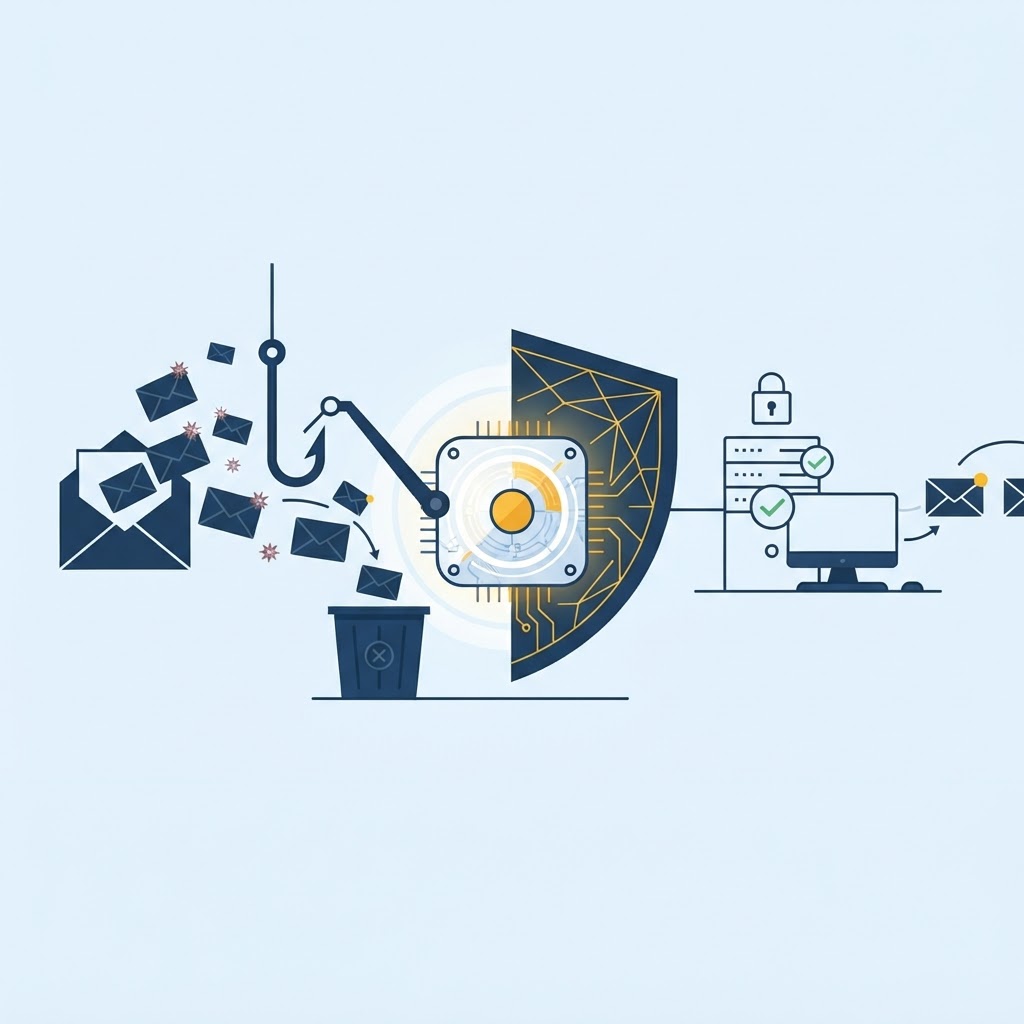
Phishing emails used to reveal themselves through strange spelling and obvious formatting. Generative AI now helps scammers produce cleaner, more personalized messages. Fortunately, AI is also strengthening the systems that stop those messages before employees see them.
It is an arms race, not an automatic victory.
What AI can examine
Modern email security can evaluate far more than the visible words. Systems may analyze sender history, message patterns, domain reputation, authentication results, links, attachments, login behaviour, and whether the communication matches normal activity.
A message can look professional and still be unusual. Perhaps a familiar supplier is writing from a new domain, the finance manager is requesting a payment outside normal hours, or an employee account is suddenly sending hundreds of messages. Machine-learning systems are useful because they can compare many signals quickly.
AI finds patterns humans may miss
Attackers constantly change wording and infrastructure to avoid fixed rules. Pattern-based models can identify similarities across large volumes of malicious activity, detect anomalies, and adapt filtering as new campaigns appear.
The Canadian Centre for Cyber Security notes that AI can support defence by analyzing high volumes of data, user behaviour, metadata, and content to identify potential threats faster. The same guidance warns that attackers use AI to create realistic, targeted phishing.
Why filters are not enough
No system catches everything. A compromised real account may pass basic sender checks. A QR code can move the malicious destination into an image. A scammer may research public information and imitate a real project, executive, or family member.
Employees should no longer rely on grammar as the main warning sign. Urgency, unusual payment requests, requests for credentials, unexpected attachments, changed banking details, and pressure to bypass normal process deserve attention.
Build layers around email
Small businesses should combine filtering with domain protections such as SPF, DKIM, and DMARC, plus multi-factor authentication, updates, limited permissions, backups, and a clear reporting process.
Create an independent verification rule for sensitive actions. If an email requests a wire transfer, payroll change, gift cards, login, or new banking details, confirm through a known phone number or another trusted channel. Do not use the contact information inside the suspicious message.
Train employees with current examples and make reporting easy. People hide mistakes when they expect punishment, giving attackers more time. A fast "I clicked this" report is valuable.
AI should reduce risk, not create false confidence
Ask your email or IT provider what protections are active, how suspicious messages are handled, and how alerts are reviewed. Test backups and incident procedures before you need them.
AI is catching more phishing because it can see patterns at a scale humans cannot. Humans still provide context, verification, and judgment. The safest small businesses use both.
Run one verification drill
Choose a fictional payment-change request and walk the team through the response. Who receives it? Which known number is used to verify it? Who can approve the change? Where is the attempt reported? The exercise should take minutes, not require a crisis binder. A simple rehearsed rule is more likely to survive urgency than a policy employees have never practised.